
Brandywine Red Maple
Original price was: $64.50.$45.15Current price is: $45.15.
- The Quality Choice for Smart Shoppers
- Shop with Confidence, Pay Safely
- Effortless Shopping, Quality Products
- Reliable Payments for Reliable Shopping

Nature is a gambler, so seedling trees – like children – are all different. When choosing a shade tree for fall color, it certainly doesn’t pay to gamble with seedling trees, because the level of fall color, its tones and its consistency from year to year, are variable. Seedling trees may be just mediocre, or they may be spectacular, and why spend 10 or 12 years growing a tree to a good size if the fall color on it is poor or unreliable? Far better to choose a named variety, that has been reproduced by grafting, preserving exactly its genetic properties, and that way you know exactly what you are getting. Fall color is not the only thing that varies – vigor, resistance to drought and heat, and even whether it will have seeds or not, are all unknown when that seedling first pushes through the ground. For a tree that has spectacular and reliable rich fall colors of deep reds, that tolerates hot southern conditions well, and that doesn’t produce messy seeds, the Brandywine Red Maple is an object lesson in the value of choosing a named tree over a seedling. It has all those virtues and more, so if those sound like features you want, you have just found your tree.
Growing Brandywine Red Maple Trees
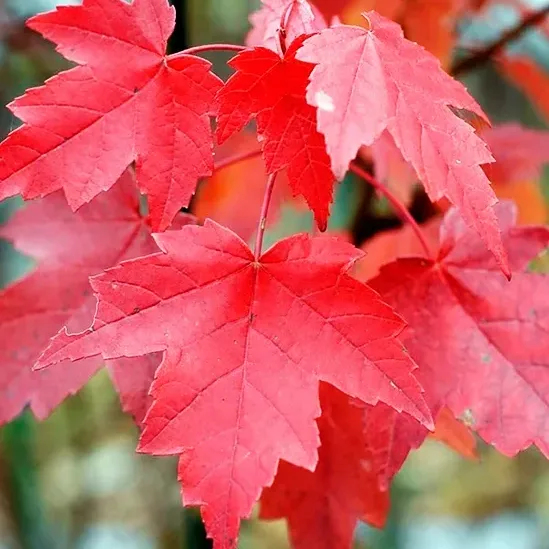
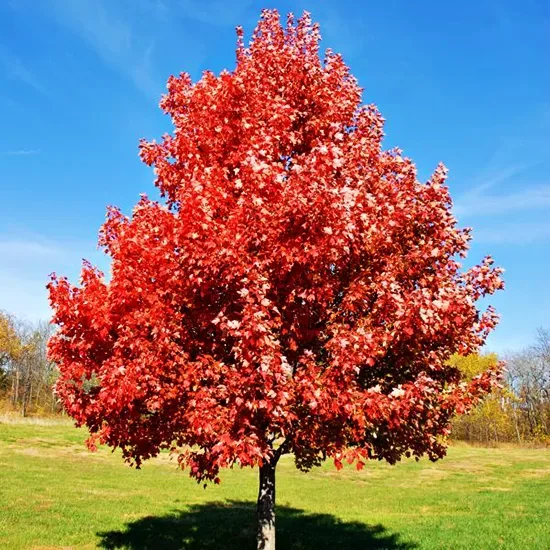
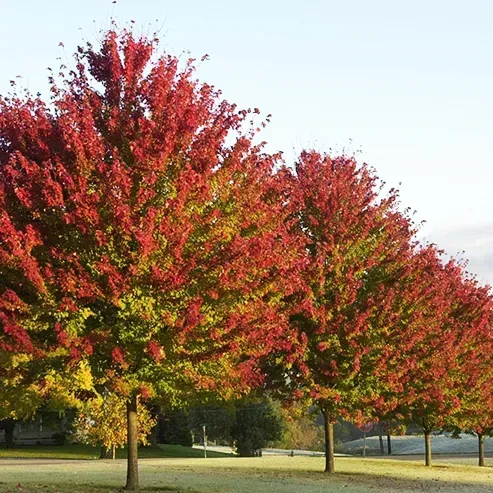
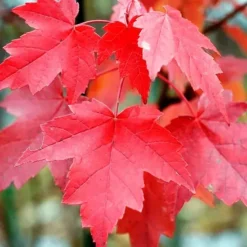
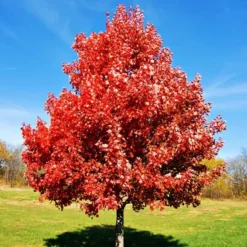
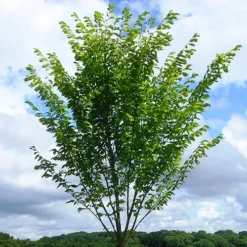
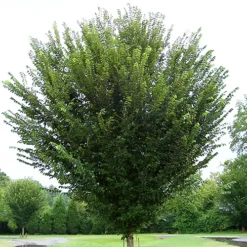
The Brandywine Red Maple grows rapidly, with a perfect pyramidal to round-oval crown structure. Within 12 years it will be 25 feet tall, and already a beautiful specimen. In time it will reach 50 feet in height, with a broad, rounded crown 30 feet across. Trees grown in the open have broader crown than those grown in more crowded places with some shade. As always, when planting, look up and check for overhead wires, and plant at least 20 feet away from buildings, boundaries or other obstructions. The leaves of this tree are 4 ½ inches long, rounded, and divided into 3 or 5 broad lobes, with serrated edges. The upper surface of the leaf is rich green, and the lower side has an interesting blue-green or sea-green tone, caused by a bluish powder which dusts the lower surface, especially when the leaves are still young.
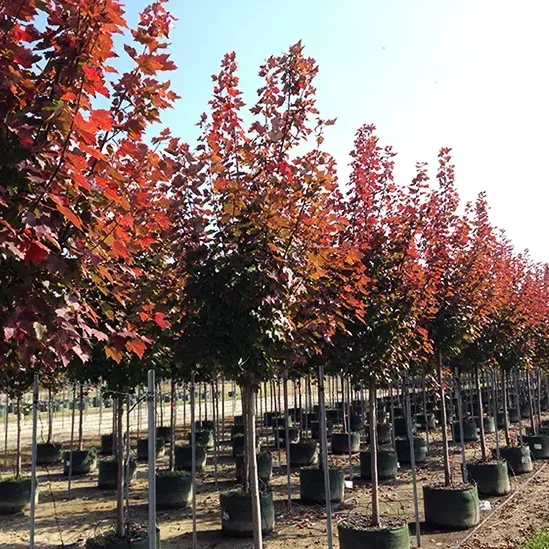
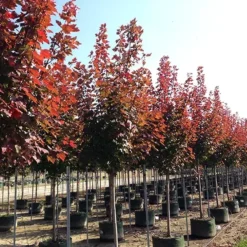
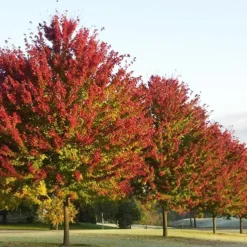
In fall the foliage of the Brandywine Red Maple turns deep, rich shades of scarlets and purplish-reds, with the whole tree coloring well, throughout the crown. This variety colors late in the season, so it extends the fall show by some extra days – and who wants it to ever stop? Planted with other varieties that turn earlier you can have fall color for weeks and weeks. Not only are the colors vibrant and powerful, but this tree is very reliable, coloring well every year, and always delivering on its promise. As this variety is a male tree, you might see small, bright-red flowers on the bare branches in very early spring, but you won’t have those annoying maple ‘keys’ fluttering around and making a mess in late summer and fall. This makes the tree ideal for a lawn or paved area, where we want to keep mess to a minimum.
The Brandywine Red Maple grows well in the cold winters of zone 4, and it grows just as well in the heat of zones 8 and 9, even in the humid southeastern states. It is much more tolerant of that heat than most other red maple varieties, so it’s a top choice for gardeners in the South. Full sun will develop the strongest fall colors, but it will also grow in partial shade. It grows well in most garden soils, and unlike many other shade trees it thrives in wet and even flooded soils, so it’s ideal for growing in low-lying areas, along streams, and beside water. It makes an excellent shade tree for a lawn, and it looks great in the corners of your property or planted along your boundary line to define it beautifully. It can also be planted in natural woodland – it is, after all, a native tree. It also grows well in urban conditions, and this is a very tough tree. It does, however, grow best on acidic or neutral soils, and it is not advised for very alkaline soils. Pests and diseases are rarely issues with this tough tree, and it grows 2 feet or more each year during its youth. It normally needs no pruning or special care, but if you do need to prune, do this in summer, not in late winter or spring, when the sap is flowing and will flow from fresh cuts, weakening the tree.
History and Origins of Brandywine Red Maple Trees
The red maple should not be confused with the red-leaf maple, which has dark red leaves in spring and summer. The Brandywine red maple has green leaves, and it is a form of the red maple, Acer rubrum, a wild tree native to North America. It grows all through the east, from Newfoundland in Canada all the way down through the eastern states into northern Florida and also eastward into Texas. The National Arboretum, in Washington, D.C., has carried out many breeding projects with different trees, to create new varieties exceptionally suited to American gardens. In 1982 they crossed two existing varieties of red maple, called ‘October Glory’ and ‘Autumn Flame’. Among the resulting seedlings they found an exceptional tree, with great color that began late in the season. They named it ‘Brandywine’, and it was released to the nursery industry for distribution, without any patent or trademark restrictions, in 1995. As we said at the beginning, it always pays to plant a named variety, and this one gives you exactly what it promises. Order your trees now, as they sell out very quickly.
Be the first to review “Brandywine Red Maple”
Related products
Maple Trees
Japanese Maple Trees
Birch Trees
Japanese Maple Trees
Shade Trees
Japanese Maple Trees
Japanese Maple Trees
Elm Trees
Reviews
There are no reviews yet.